|
|
Here’s a few photos from the Bhaktivedanta Archives of Mayapur circa 1972-1980. It serves to remind us that Mayapur has been a continuous development and will continue to be so. Just as rice paddies were turned in to parks and fountains, now the parks and fountains are making way for something new–the Temple of the Vedic Planetarium.
Here’s how it all began:

International Headquarters 1971
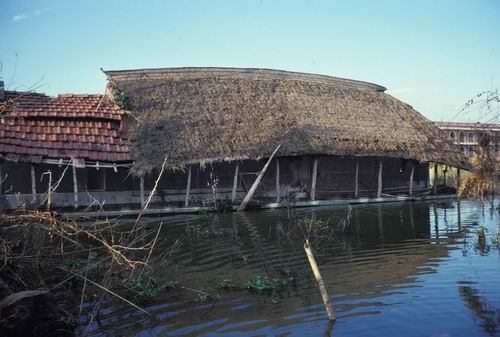
During a flood 1979
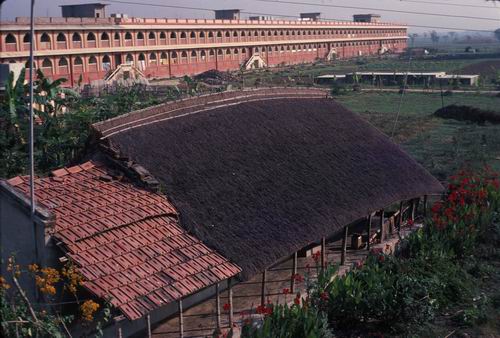
Circa 1980
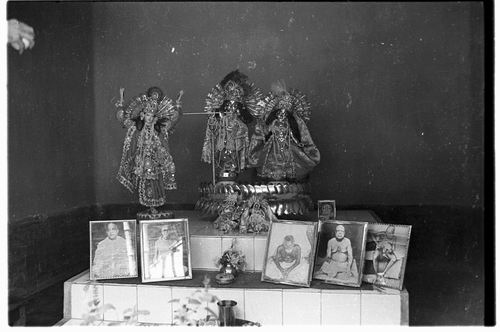
Eternal Residents of Mayapur, Sri Sri Radha Madhava and Sri Caitanya-1971
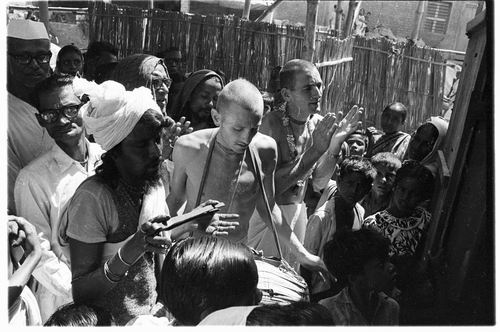
and Their eternal servants

the transcendental twins about whom Srila Prabhupada said "These twins, everyone should know it, there is no comparison."

Their Lordships and Their intimate servants--1979

Sri Sri Radha Madhava 1979
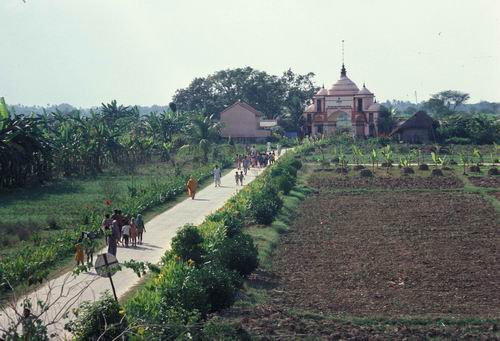
from the Lotus building to the main gate 1976

1980

1980 - Lotus building

Gurukula boys 1980

So what are you waiting for? Come and visit Mayapur...
Great news from Mayapur. Here’s a few photos I took today. As you can see, some major changes are taking place. The park is being cleared in preparation for the ground work to begin on the Temple of the Vedic Planetarium (TOVP).
There is a good deal of nostalgia for the park, the famous Lotus Fountain, the lawns and trees and flowers. Literally tens of millions of visitors (four million just during last year) have enjoyed the peaceful environs of the ISKCON Mayapur Candrodaya Mandir gardens and they have served us well. Still I can’t help but be elated in seeing the acceleration of the demolition as preparations gear up.
By January we hope to see the pile drivers in place and work on the foundations begin in earnest. In early February the entire GBC body will attend an inaugural ceremony to create an auspicious beginning for the works. If you are coming for Gaura Purnima, be prepared for some major changes!

The park area circa 1976

Lotus Fountain -- the beginning (circa 1980)
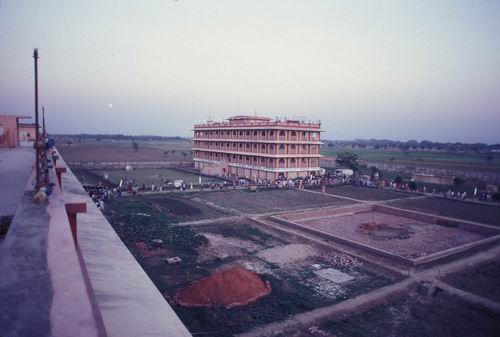
Lotus Fountain -- the beginning
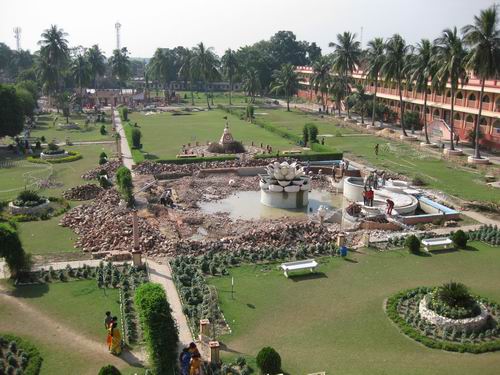
And the end... November 2009
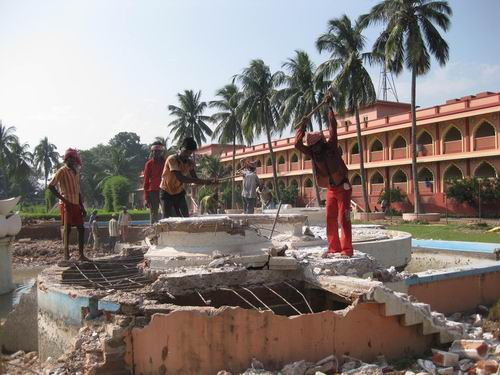
After nearly 30 years of service, the Lotus Fountain goes under the hammers
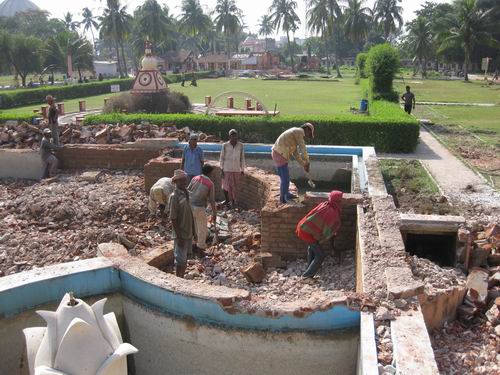
30 years and millions of visitors later, the Lotus Fountain bids adieu
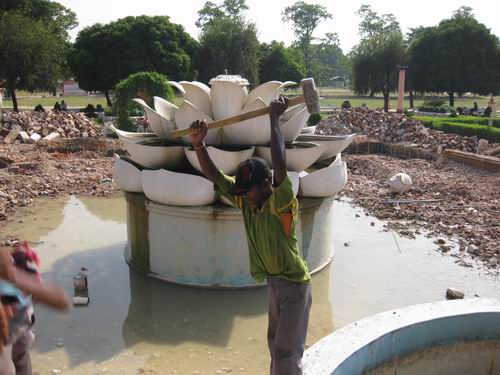
All things must pass
Here’s the new perimeter demarking the boundary of the TOVP. These poles will be adorned with tin sheets and the whole area will be off limits to visitors while the construction goes on.

TOVP perimeter fence poles go in
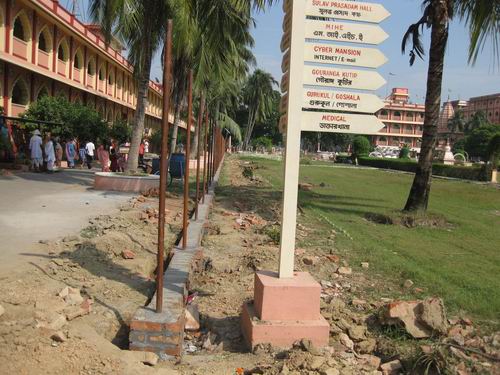
Take a last look, by Gaura Purnima this will be a solid fence
One place I was particularly glad to see dismantled was this:
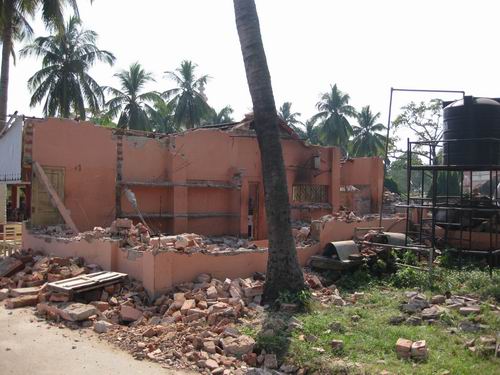
Govinda's dhaba bites the dust
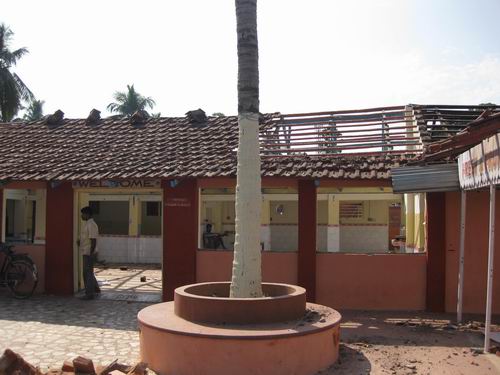
Going, going, ...
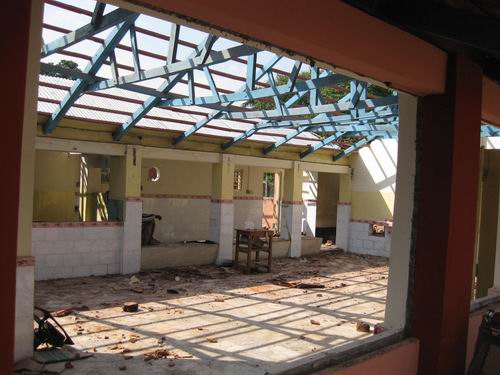
Gone-vindas
A new first class restaurant is under construction and will be operational within two months. It will comprise of three areas-Bengali cuisine, Indian cuisine, and an air conditioned full service Italian restaurant. Another area will be for snacks and take-aways so that sit down diners will not be disturbed. There will be three kitchens with different crews cooking for each one.
Here’s the second part of the question regarding Srila Prabhupada’s alleged projection of personal sexual frustration into his presentation of Krsna consciousness:
Question:
Here is the phrase in question, corresponding to SB 10.58.17-19. The troublesome words are two, “raised breasts” [which are not in the original Sanskrit]. We would be very much pleased to hear your expert opinion in regard to this matter.
Quote from Krsna book, chapter 58: “Five Queens Married by Krsna”
“While resting and drinking water, they saw a beautiful girl of marriageable age walking alone on the bank of the Yamuna. Krsna asked His friend Arjuna to go forward and ask the girl who she was. By the order of Krsna, Arjuna immediately approached the girl, who was very beautiful. She had an attractive body, nice, glittering teeth and a smiling face. Arjuna inquired, “My dear girl, you are so beautiful with your raised breasts. May I ask you who you are? We are surprised to see you loitering here alone. What is your purpose in coming here? We can guess only that you are searching after a suitable husband. If you don’t mind, you can disclose your purpose. I shall try to satisfy you.”
Answer:
This reply is a little lengthy but it is necessary in order to establish the proper perspective on this question. This is a serious issue and I humbly request you to please give this a serious read.
In giving this description in his summary study ‘Krsna’ Srila Prabhupada is simply following the lead of Srila Vyasadeva, the author of the Srimad Bhagavatam.
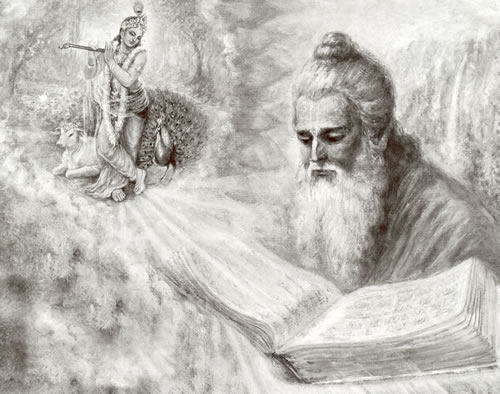
In the SB there are many places where the beauty of a woman includes a description of her breasts. They are mentioned specifically as being “raised” “projecting upwards” etc. I will give some examples of this later in this text.
What to speak of material women, there are specific descriptions of Krsna’s queens, or the Gopis intimately playing with Krsna, which also mention that a component of their spiritual beauty is their attractive breasts, which are sometimes compared to cakravaka birds.
Consequently, when Srila Prabhupada includes the phrase “raised breasts” in his summary study of the 10th Canto description of the meeting between Krishna, Arjuna and Kalindi, Srila Prabhupada’s addition of this phrase is not at all material, nor is it a product of his lust, frustration, attraction to the forms of material women etc. It is a factual parampara expression of the transcendental beauty of one of Lord Krsna’s eternal and most intimate devotees, His wife Kalindi. Even though it is not directly in the text, it is still a fact and Srila Prabhupada’s addition of it is perfectly spiritual.
Kalindi is part of the internal energy of the Lord. She is a direct expansion of Radharani.
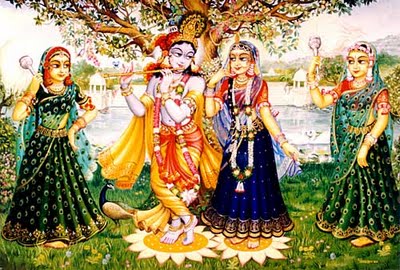
She is the Yamuna personified and one of the eight principle queens of Lord Krishna. As such there is no material aspect to her beauty. As Srila Prabhupada writes in the SB 1st Canto:
SB 1.11.31
“Unbelievers become astonished to learn that Lord Krsna married more than 16,000 queens because they think of Lord Krsna as one of them and measure the potency of the Lord by their own limited potency. One should know, therefore, that the Lord is never on the level of the living beings, who are but expansions of His marginal potency, and one should never equalize the potent and the potency, although there is very little difference of quality between the potent and the potency. The queens were also expansions of His internal potency, and thus the potent and potencies are perpetually exchanging transcendental pleasures, known as pastimes of the Lord.”
And again, according to Srila Visvanatha Cakravarti Thakura,

as quoted by Hridayananda Maharaja in his purport of SB 10.83.40:
“In the opinion of Srila Visvanatha Cakravarti, Srimati Laksmana became embarrassed when she realized that she had been talking about herself, and so she spoke this verse praising her co-wives. In her humility Laksmana claimed that Krsna’s queens, unlike ordinary wives, could not bring their husband under control, and thus they could relate to Him only as servile housekeepers. In fact, however, since the Lord’s queens are direct expansions of His internal pleasure potency (hladini-sakti), they fully controlled Him with their love.”
Srila Jiva Goswami in his Krsna-sandarbha, describes the queens of Krsna as expansions of His internal potency, and Srila Sukadeva Goswami, at the end of his narration of Narada Muni’s visits to the palaces of the queens of Dvaraka, says,
“Lord Hari is the ultimate cause of universal creation, maintenance and destruction. My dear King, anyone who chants about, hears about or simply appreciates the extraordinary activities He performed in this world, which are impossible to imitate, will surely develop devotion for the Supreme Lord, the bestower of liberation.”
Srila Prabhupada summarizes this verse in the Krsna book by saying:
“In narrating the activities of Lord Krsna in Dvaraka, Sukadeva Gosvami explained to King Pariksit how Lord Krsna, the Supreme Personality of Godhead, descends to this material universe by the agency of His internal potency and personally exhibits the principles which, if followed, can lead one to achieve the ultimate goal of life. All the queens in Dvaraka, more than sixteen thousand in number, engaged their feminine attractive features in the transcendental service of the Lord by smiling and serving, and the Lord was pleased to behave with them exactly like a perfect husband enjoying household life. One should know definitely that such pastimes cannot be performed by anyone but Lord Sri Krsna, who is the original cause of the creation, maintenance and dissolution of the whole cosmic manifestation. Anyone who attentively hears the narrations of the Lord’s pastimes in Dvaraka or supports a preacher of the Krsna consciousness movement will certainly find it very easy to traverse the path of liberation and taste the nectar of the lotus feet of Lord Krsna. And thus he will be engaged in Lord Krsna’s devotional service.”
Therefore if Srila Prabhupada, as a pure devotee, includes an additional description of Kalindi’s beauty, there is no wrong in that, it is rather an aspect of his service and glorification of the Lord and His internal devotees. It is meant to show us that the great devotees of the Lord please Him by their personal beauty and service attitude which is all offered for His pleasure.
Now I shall give some examples where Srila Vyasadeva has included in the SB some descriptions of the breasts of women. In reading this you can just reflect on whether Vyasadeva was doing this because of his own frustrated sex life, or because there is some transcendental purpose.
From time to time I hear comments or get asked questions which imply that Srila Prabhupada was affected by his apparently material circumstances that existed before his becoming the Founder Acarya of ISKCON.
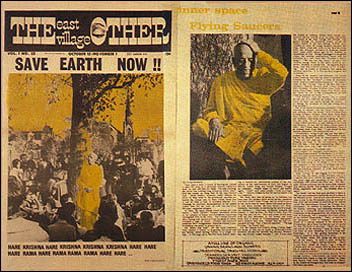
As it goes, the accusation states that Srila Prabhupada’s presentation of Krsna consciousness, its practice, was tainted by his personal failures or by his upbringing in early 20th century Bengal. One such critique centers on his explanations of the intelligence of women; another on his insistence of the four regulative principles; another on his comments about the moon. And the list goes on.
It is to be expected because this is Kali Yuga and people cannot easily escape their conditioning and see things from the transcendental perspective. The tendency is to modify transcendental teachings to fit within their own conditioned frameworks.
ISKCON is going the same way all pure spiritual movements go in Kali-yuga. It is being materialized by people who don’t have the ability or desire to transform themselves or be transformed, and instead transform Krsna consciousness to their mundane convenience.
As George Bernard Shaw once wrote:

“The great danger of conversion in all ages has been that when the religion of the high mind is offered to the lower mind, the lower mind, feeling its fascination without understanding it, and being incapable of rising to it, drags it down to its level by degrading it.”
Even though this trend is to be expected, I was still surprised to hear this latest criticism of His Divine Grace, sent to me for comment by one of our Mayapur devotees:
I just saw a blog by Vineet Chander called ‘OmSweetOm’. It was all about a new Halloween costume based on the Hare Krishna look: http://blog.beliefnet.com/omsweetom/2009/11/a-hare-krishna-halloween.html#preview
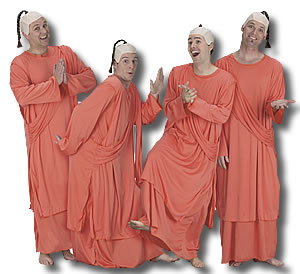
Hallowing the Holy Name
Inevitably there are calls to protest this ‘insult’ to Krishna consciousness and Hinduism. Vineet gives a reasonable perspective on why he thinks we should not, but he misses the real point.
According to the Caitanya Caritamrta if a person somehow chants the holy names, even in joking, they get transcendental benefit:
Adi 17.200
sei haite jihva mora bale ‘hari’ ‘hari’
iccha nahi, tabu bale, — ki upaya kari
TRANSLATION
“‘Since that time, my tongue also always vibrates the sound “Hari, Hari.” I have no desire to say it, but still my tongue says it. I do not know what to do.’
PURPORT
Sometimes demoniac nonbelievers, not understanding the potency of the holy name, make fun of the Vaisnavas when the Vaisnavas chant the Hare Krsna maha-mantra. This joking is also beneficial for such persons. Srimad-Bhagavatam, Sixth Canto, Second Chapter, verse 14, indicates that the chanting of the Hare Krsna maha-mantra, even in joking, in the course of ordinary discussion, in indicating something extraneous, or in negligence, is called namabhasa, which is chanting that is almost on the transcendental stage. This namabhasa stage is better than namaparadha. Namabhasa awakens the supreme remembrance of Lord Visnu. When one remembers Lord Visnu, he becomes free from material enjoyment. Thus he gradually comes forward toward the transcendental service of the Lord and becomes eligible to chant the holy name of the Lord in the transcendental position.”
Vineet’s article got it right, although he didn’t fully explain why the ‘halloween Haris” is Ok. Srila Prabhupada gives the explanation above. To chant Hare Krishna is better than to not chant Hare Krishna, even if it is done in jest, which the Halloweeners most certainly do. They are chanting Hare Krishna throughout the Halloween festival which they may never have done otherwise.
Think about it–they spend at least a few hours imitating a Hare Krishna devotee. Now think about another great imitator and the result she got…
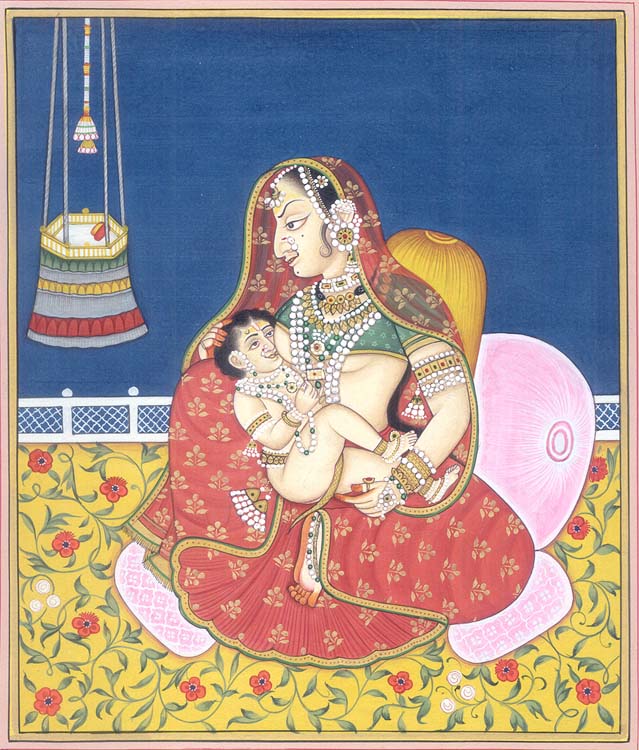
Srila Prabhupada was always pleased to see Krishna’s names chanted, even in apparently adverse circumstances. It reminds me of when I was with him in Calcutta on February 5th 1977. An article had come out in a Boston newspaper asking whether the Hare Krishna devotees were good or bad:
[Note: excerpted directly from my original diary. This has not yet edited or been published]
On Thursday 22 October 2009 we celebrated Srila Prabhupada’s 32nd Disappearance anniversary
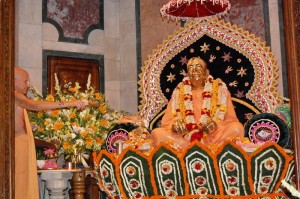
Samadhi arati
here in Mayapur. It was a transcendentally enlivening event, attended by approx. 4,000 yatris from Mumbai and other places, who are all here with HH Radhanath Swami for their Kartika Navadvipa-mandala-parikrama.
We listened to profound recollections, realizations and lilas from Srila Prabhupada’s disciples including Their Holinesses Ramai Swami, Kavicandra Swami, Umapati Swami and Radhanatha Swami, as well as HG Sitala dasi, Ragatmika dasi, Kulingana dasi, Rajendranandan dasa, Pancaratna dasa, Suresvara dasa, Sauri dasa, Bhavananda dasa and many others. We were also glad to welcome and hear from HH Bodhayan Maharaja,

Kavicandra Swami, Radhanatha Swami, Bodhayana Swami
the Acarya of the Gopinatha Gaudiya Matha founded by His Divine Grace Bhakti Pramoda Puri Maharaja.
Afterwards we observed puspanjali and maha-arati in the Puspa Samadhi and this was followed by a wonderful feast,
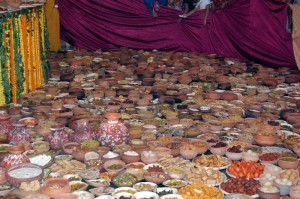
cooked in the best traditions of ISKCON Mayapur. In the evening we gathered again to hear from Mayapur’s transcendental twins Jananivas and Pankajanghri prabhus and others, before observing the actual time of Srila Prabhupada’s disappearance by singing “Ye anilo prema-dhana….” followed by arati and prasadam distribution.
I can say that personally I thought it was one of the best disappearance festivals I have attended. Many of the talks, especially those of Rajendranandan prabhu and Sitala dasi, were deeply appreciated, and you can download those from the Mayapur website www.mayapur.com
But that’s not what this blog is about. I want to mention another smaller, more personal anniversary.
The Disappearance day this year marked the 20th anniversary of my personal worship to my Deity of Srila Prabhupada.
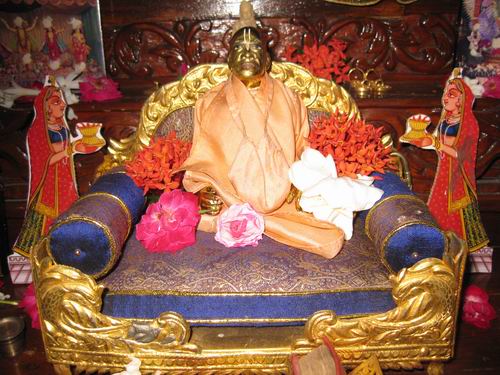
I guess its a milestone, a marker of devotion. Of course, our worship of Srila Prabhupada is eternal and unending. In that perspective, 20 yrs. isn’t much. But from the view point of a limited life in this Kali-yuga body, it represents one third of my current life’s duration. So I am happy to have achieved it. I want my personal service to His Divine Grace to go on and on, and my little bit of one hour puja everyday helps keep me connected in a way that performing other services don’t.
In late 1988 I was feeling a little adrift. In 1984 I had given up my sannyasa, and with it all my services as GBC of the South Seas. It took me several years to get over the turbulence and by 1988 I was feeling more positive but also feeling a real need to connect with Srila Prabhupada through some personal service. I started to think about worshipping his Deity but in Australia none was to be found. So I decided I would look in Mayapur and Vrindavana at the1989 Gaura Purnima festival.
In February 1989 then, I came to India. I had a cursory look around Navadvip but I knew there would not be much on offer and that Vrndavana would be the best place. In early March I went out to Loi Bazaar and spent the best part of a day seeking a nice Deity but to no avail. I returned to Krsna Balaram Mandir disappointed.
Next morning I had an appointment to see Bhurijan prabhu
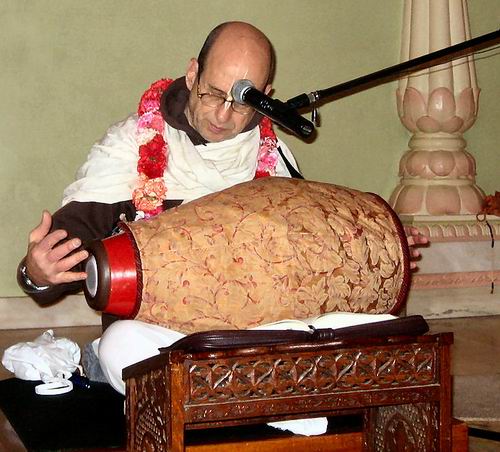
on the top floor of the Gurukula. As I approached his room, I ran into Aindra prabhu.
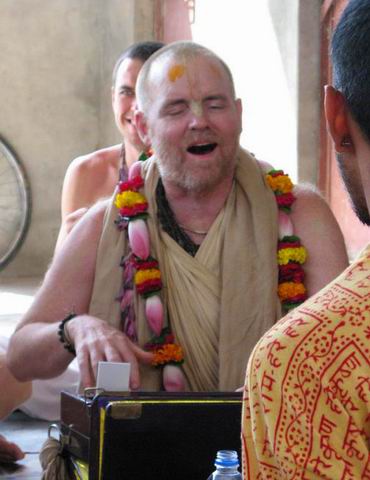
We are old friends and it was during my tenure as GBC of New York in 1982 that, with my encouragement, Aindra made the decision to come and live in Vrndavan. So here he was, standing outside his room, effulgent and smiling and happy to see me. We talked, and he invited me to see his Deities that he was keeping for his personal puja.
Stepping into his room was an event. The whole place was plastered in cow dung, from top to bottom. In the center, taking up most of the space, was a large wooden simhasana with a host of Deities residing there. I was impressed. As we talked, I suddenly thought, “I wonder if Aindra knows where I can get a nice Deity of Srila Prabhupada.”
As soon as I gave voice to my thought, he dipped his hand behind a curtain covering a set of concrete shelves and instantly produced a beautiful murti of His Divine Grace. “Here, you can have him prabhu. He was given to me six months ago but I haven’t worshipped him because I already have another Deity of Prabhupada on my altar.”
I immediately took it as a confirmation from Srila Prabhupada that he wanted me to begin personally worshipping him again. The Deity was exactly what I was looking for. The right size for traveling, and nicely formed. It looked like Srila Prabhupada. I was very happy.
But I didn’t begin worshipping him immediately. I needed to get myself properly situated before I undertook a task I knew that I could not stop once I started. Being “properly situated” meant getting my asrama status in order. i.e. I needed a good devotee wife to stabilize my life so that I could make steady progress in devotional service. Together we could take up the worship. If for some reason I could not do it one day, she could do it instead.
I thought about an incident in Hyderabad in August of 1976. At the opening of the temple Srila Prabhupada had been given a shaligram-shila by Sri Sampath Kumar Bhattacarya, the leader of the S. Indian pandits who had done all the rituals for the installation and opening. Later he called Pradyumna prabhu into his room:

Pradyumna is on the far right
August 21 1976- Hyderabad
[TD4]
Prabhupada turned to Pradyumna prabhu. He asked him if would like to personally worship the salagrama-sila given by Sampath Kumar, which was still sitting on his desk. He obviously had changed his mind about sending the Lord to the Bombay temple.
Prabhupada turned to Pradyumna prabhu. He asked him if would like to personally worship the salagrama-sila given by Sampath Kumar, which was still sitting on his desk. He obviously had changed his mind about sending the Lord to the Bombay temple.
Pradyumna was readily agreeable and so Prabhupada gave him some simple instructions. “So we can carry, and every morning just put in a simhasana and tulasi and water and flower and little fruit. That’s all.” Then turning to the rest of us he said, “He has got tendency to worship.”
“He is brahmana, pandita,” Gargamuni added.
“Panditji,” Prabhupada smiled, calling Pradyumna by his popular sobriquet.
Gargamuni mentioned that Pradyumna was also training his son, Aniruddha, and Prabhupada smilingly added, “Yes, his son will be great pandita. Both of them are devotees — husband and wife; therefore nice son is born. Yatha bijam yatha yoni. Yoni is the mother, bijam is the father.”
Then Prabhupada digressed a little, fondly recalling how his own father, following the advice of his spiritual master, always traveled with salagrama-sila hanging around his neck wrapped in a linen handkerchief. “Yes. So it is safe always, kantha. My father used to carry. Wherever he would stay, ganga-jala, tulasi, decoration; say, half an hour business. My father was a great devotee, yes.”
With the onset of my addled old age I am losing my ability to count. I posted Questions from the CIS #5 before I posted #4. My apologies. Here’s the missing question and answer:
Question 4.
Tell me, please, did Prabhupada mention that it is possible to chant the rounds instead of someone? Or in the time of chanting to pray for someone? Is it authoritative to give the results of oblations, for example ekadashi fast, to someone? Thank you! Hare Krishna!
Answer:
I think you mean, “Is it possible to chant rounds on behalf of someone else?”
Chanting rounds is something we do for our own advancement, so its difficult to think that someone could chant rounds on behalf of someone else. However, if when we chant our rounds, we pray for the benefit and purification of someone else, certainly that person will get great benefit.
The results of oblations can certainly be given to others. The great example is Dadhici,
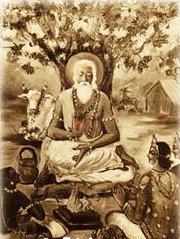
who gave his bones to the demigods for their benefit. That means he voluntarily sacrificed his own material body for their benefit. Similarly, a devotee can fast and offer the results of their austerity to the credit of someone else, and that person will definitely get the benefits.
Krsna is very merciful and He especially likes to please His devotees. If a devotee prays for the welfare of another living being, Krsna is eager to fulfill His devotee’s request. He does so out of love. So even if a person is not deserving, if a real devotee prays for that person, Krsna will help them because of His love for His devotee. He does not take into account the disqualification of the recipient, only the love of His devotee.
We were not at all qualified to worship Krsna but because Srila Prabhupada requested Krsna to benedict us, we were able to come out of very dense ignorance very quickly. Krsna responded very powerfully to Srila Prabhupada’s request because Srila Prabhupada was so intensely eager to please Lord Caitanya and his spiritual master.
Prahlada Maharaja was able to save his demonic father Hiranyakasipu simply by his own devotion to the Lord. When Lord Nrsimhadeva had killed Hiranyakasipu,
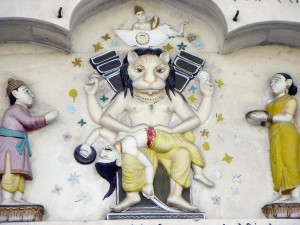
He asked Prahlada to ask for any benediction he liked:
Here’s the fifth question from the devotees in the CIS, which is in two parts:
Question 5-1.
Hare Krishna, dear Hari Sauri prabhu! Please, accept my humble obeisances!
Please, tell me what can be done if I want to take a daily service to Sri Krishna, to go to lectures, attend programs and participate in sankirtana, but reading the morning japa is not going well. If this oblation make my body feel bad, and I’ m not rather of myself, because “bad” thoughts all time go to my mind, and the feeling of happiness at the end of the 4th circle is not always achieved, and if achieved, then quickly disappears, and sometimes I cannot even read the 3 laps? Although I can easily read 4-8 rounds in daily or evening time mentally.
Answer:
The basis for all our other service is the chanting of the Holy names.
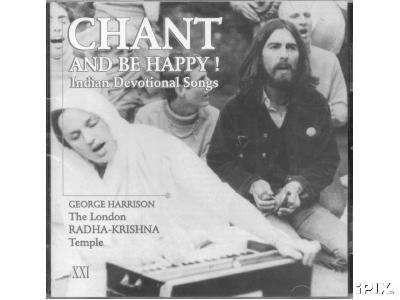
Srila Prabhupada prescribed the chanting of a minimum 16 rounds per day if we want to make steady advancement. We can judge whether we are making progress by our desire and ability to chant at least 16 rounds daily. In Chaitanya Caritamrta Srila Prabhupada says that if we cannot chant 16 rounds daily we are in a diseased condition of spiritual life.
There is a cartoon Srila Prabhupada once saw in an American newspaper. An old man and an old woman were sitting on a park bench watching a group of devotees chanting. The old woman turned to the old man and said, “Chant, chant, chant!” The old man replied, “Can’t, can’t, can’t!” Srila Prabhupada cited this in a class and to the laughter of the devotees he said that unless one is on the liberated platform, he cannot chant the Holy Names. So conversely, if we are chanting regularly, then we should know we are on the transcendental platform.
So I would recommend that before any other service, your chanting should come first. And then whatever you can do after that is fine.
If you feel that your chanting is artificial and you often don’t have any feeling for it, it doesn’t matter. In the beginning we may not have a higher taste and it may be difficult to chant. But by practice you can gradually develop a good taste for it.
The example is given of a man who has jaundice. When you have jaundice you lose your taste for sugar; in fact it becomes very bitter–actually the sugar is not bitter but the diseased man’s taste is distorted so that it seems bitter. Nevertheless, eating rock sugar is the cure for jaundice. As the disease diminishes, the taste of the suger comes back. When the man is healthy, the sugar again tastes very sweet. Similarly, we are in a diseased condition of material existence and we do not like to glorify and take shelter in the Holy Name, which is Krsna Himself. Still we should chant because chanting is both the means (cure) and the goal.
Even if it feels artificial, it will still act because the Holy Name is real, it is not an illusion. It is our bitter perception and our disturbed mind that is not real and that has to be changed. By constant chanting the change will come naturally.
Question 5-2:
And also, please, give me advice about mosquito problem. There are bugs around my place and every summer evening, in spite of any efforts, the mosquitos penetrate into the apartment. It is impossible to suffer them but having knowledge to use different fumigator is unpleasant.
Answer:
Srila Prabhupada advised us not to kill any living being if we can avoid it. However, if we are attacked,

we can defend ourselves.

When I was with Srila Prabhupada we used a number of methods to stop them attacking His Divine Grace while he was translating in the night:
[From Transcendental Diary Vol 1]
January 18 1976 – Mayapur
In the early evening, just on dusk, a few of the senior devotees and myself were sitting with Prabhupada in his room, conversing. From a distance and gradually drawing nearer, we heard the loud trumpeting of a conch shell accompanied by bell ringing and the chanting of mantras. Bhavananda Maharaja laughed and told Prabhupada it was Anantarama Sastri, an Indian devotee in his mid-twenties who joined us last year with three other sastris. Unfortunately the others left, but he has stayed on. As his name implies, he is very knowledgeable in the scriptures and well-versed in the performance of various types of puja. He can also quote practically any Sanskrit verse from memory.
Bhavananda explained that each evening as the sun goes down, he tours the building, floor by floor, with a bell, conch, and a large, clay incense burner, chanting various mantras to keep away ghosts and other subtle beings.
The sound grew louder and Prabhupada smiled in welcome as Sastri entered his room in a cloud of frankincense, the reverberations of the conch temporarily drowning out our conversation. It was an impressive ritual, made more so by Sastri’s ability to both blow air through his mouth and suck it in through his nose at the same time, thus keeping the conch blowing uninterruptedly for several minutes. He walked around both rooms, waving a bamboo fan over his clay bowl to disperse the fragrant smoke. It also acts as an effective mosquito repellent. After a couple of minutes he respectfully backed out the door and continued his nightly round.
Here’s number three:
Q3. Hare Krishna! Please, accept my humble obeisances, Hari Sauri prabhu!
You said “Islam is definitely mayavada as is Buddhism”, but how it can be, if the Lord Chaitanya in the dispute with Abdullah Patani proved that Allah is personality in the Koran? And besides, even if someone worships to impersonal aspect of God, can we call him mayavadi because impersonal aspect is also God?
Ans: While its a fact that a deep reading of the Koran can reveal that God is ultimately the Supreme Person,

800 years old Koran
as Sri Caitanya Mahaprabhu explained,

the fact is that almost all Muslims are in denial of this.
As I understand it, in the Koran there is an injuction that one should not ascribe mundane characteristics to God, or describe Him in mundane terms. They think it is the greatest offence to speak about God in personal terms–to describe his characteristics and form etc. They think He is so great that He cannot be described and that to describe Allah as a person is to reduce him to ordinary human status or to make him simply a product of our mundane experience or minds.
This is typical mayavada thinking. Thus you will see in Vrindavana and other places in India so many temples where carvings depicting demi-gods or Krsna Himself, or the Dasa-avataras, have been smashed by invading Muslim forces. The faces, hands and feet of these figures have especially been destroyed.
As far as whether a person who worships the impersonal feature of the Lord is a mayavadi or not, that depends on their mentality. There is a difference between an impersonalist and a mayavadi.
Some persons, as they progress in spiritual understanding, come first to an appreciation of the impersonal Brahman. If they are not offensive, they may progress further to Paramatma realization and finally to Bhagavan. This is because each stage has some aspect of bhakti, and because of this Krsna is disposed to reveal Himself more and more. The four Kumaras are examples of this, as is Sukadeva Goswami.
The mayavadis however are those unfortunate souls who, after realizing the all-pervasive aspect of the Lord, stop at that point and claim that God cannot be anything other than impersonal.
They decry the other stages of realization, they decry the spiritual form of the Lord and they interpret the incarnations of Krsna and His many forms as transformations of material nature. They are in fact offensive to the Personality of Godhead and because of this they cannot make any further advancement. In fact, when they leave their bodies they becomes almost non-entities like stones or trees.
So we have nothing against a genuine impersonalist, if they are progressive in their spiritual quest. But we reject the mayavadis outright because they can destroy a person’s whole spiritual advancement with their word jugglery and their envy of the Supreme Lord.
Your humble servant,
Hari-sauri dasa
Here’s the second question:
Q2. Please, accept my humble obeisances! All glory to Srila Prabhupada! Tell me, not devotee person is able to wear cantimala?
Ans: I presume this means, “Can a non-devotee wear kanti-mala?”
I don’t see why not. Certainly a person is going to benefit from wearing tulasi beads around their neck even if they are not a devotee. It is similar to a non-devotee taking prasadam or hearing the Holy Name. If a person imitates the devotees by wearing tulasi beads around their necks they will benefit. This is called ajnata-sukriti, unknowingly acquiring spiritual merit.
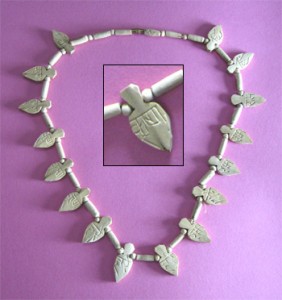
Tulasi devi is all-auspicious and if someone dies wearing Tulasi beads on their body, they are purified of all sinful reactions:
“A similar statement is in the Skanda Purana, which says, “Persons who are decorated with tilaka or gopi-candana [a kind of clay resembling fuller’s earth which is produced in certain quarters of Vrndavana], and who mark their bodies all over with the holy names of the Lord, and on whose necks and breasts there are tulasi beads, are never approached by the Yamadutas.” [NOD-9 Tilak and Tulasi Beads]
Your humble servant,
Hari-sauri dasa
I just received a few questions from the Russian forum so I will try to post them one by one.
Q1) Here’s question one (questioner was not identified):
Dear Maharaj. I have a question to you which probably was asked to you not once. 4-th principle. More and more they say it is possible in the family life. I don’t doubt in it at all. But what about the people who gave vows. If the mataji gives a vow, and then getting marry with not initiated devotee. Or just with friend of Krishna.
The situation is: Mataji is getting marry with vegetarian, who likes Krishna’s consciousness. This lovely guy does not want to follow to 4-th princip at all. But their relations are getting to the serious level. And in this moment older vaishnavs offer to take [give] initiation this mataji as soon as it possible, she was dreaming about it last 10 years. What should she do in this case? Broke relations which are close to marriage? Or for example to get initiation and then just follow her matrimonial debt, implying that husband violates it, but not she? ))
Ans:
First of all, please don’t address me as ‘Maharaja’, I have a long way to go before I become qualified for that title!

This is the closest I will come to being a Maharaja!
‘Prabhu‘ is our usual way of addressing each other.
I don’t know these people personally so I can only answer this in a general way.
I think this girl is being tested by maya. Just as she is coming close to making a committment to Krsna by accepting the vows of initiation, along comes an ordinary soul who does not even want to follow the basic principles of human life, what to speak of the spiritual principles for making advancement back to Godhead, and she becomes attached to him.
This will end in spiritual disaster for her if her boyfriend is not interested in being a devotee. Not only is he not going to following the ‘no illict sex’ principle, which will make it impossible for her to observe also, but it seems from your question that he is an intoxicator etc. Even if he is a vegetarian, that is not an indication that he wants to develop spiritually. So where is there any question that a devotee can be happy being married to such a mundane person? If she wants to move closer to Krsna then marriage to this man, no matter how lovely he seems to be, will not help her.
The bare facts are that after a couple of years of marriage the ‘honeymoon’ period is over and things become routine and hard work. The excitment of each other’s company becomes less and the daily uninspiring routines take over. If this girl has already developed a taste for Krsna consciousness, it will become difficult for her if her husband does not want to encourage or cooperate with her spiritual efforts.

However, if he is not inimical to Krsna consciousness, if he is interested in devotional life, then maybe she can gradually bring him closer to Krsna by her own devotional practice. That can sometimes happen but it is difficult.
I am sure there are other perspectives on this, but this is one you might consider seriously.
Your humble servant,
Hari-sauri dasa
September 14 2009
The other day I visited Srila Prabhupada’s remaining family members, his youngest son Vrindaban Candra De, and his youngest daughter Bhaktilata mataji. It was the first time I have been to their flat since 1976 when Srila Prabhupada purchased it for them:
[From TD1]
January 12 1976 Calcutta
Sudama, Jayapataka, and Sridhara Swamis and other devotees met us at the airport.
Rather than going straight to the temple, Prabhupada first went to inspect a flat he is thinking of purchasing for his former family members. Then he traveled to the temple in our own bus.
January 14 1976
After breakfast prasadam Prabhupada and I went to see an apartment at Park Circus. He is thinking of purchasing it for his son and daughter, who met us there. Prabhupada didn’t say very much to them, and after a few minutes we returned to the temple.
January 15 1976
Later in the morning Prabhupada went to see another flat. And then just before massage time he sent me to show two friends of his the place we saw yesterday.
[end quotes]
Srila Prabhupada bought the flat near Park Circus and gave the keys to his son Vrindaban in February 1976 in Mayapur. They have lived there ever since. Under an arrangement made by Srila Prabhupada in 1977 shortly before he left us, the family receives a small allowance every month and the maintenance of the flat is paid for by the Mayapur Vrindavan Trust (MVT) of which I am the current secretary.
I went to inspect the flat and make preparations for some overdue repairs. While there I met Smt. Bhaktilata for the first time. Just like other members of the family, and especially Srila Prabhupada’s sister, whom we call Pishima (aunty), Bhaktilata looks strikingly similar to Srila Prabhupada:

Pisima on November 15 1977, the morning after Srila Prabhupada's disappearance in Vrindavana
I was happy to see the family worship small Radha Krsna Deities every day, along with a small murti of Srila Prabhupada. They have pictures on the walls and I was checking one out in particular:

A.C. Bhaktivedanta Swami-Chippiwada Delhi 1964-5
I knew it had been taken at the temple in Chippiwada Delhi and I was fasinated to see it on Vrindaban Candra’s bedroom wall. As I inspected it, Vrindaban informed me that he had taken the photo himself on a small box camera when he was visiting his sannyasi father for three weeks while he was in residence at the Radha Krishna temple of Pandit Sri Krishna Sharma. I have seen the photo before in the Prabhupada Lilamrta but it was uncredited. I was very happy to finally find out who the photographer was and I surmised it must have been taken in early 1965, because Srila Prabhupada is sitting with all three volumes of the first canto of his English version of Srimad Bhagavatam, and the last volume had been publish in late 1964.
Satsvarupa Maharaja writes about Srila Prabhupada’s residence in Chippiwada in the first volume of Srila Prabhupada Lilamrta:
August 3 2009
A popular travel documentary a few years back on the BBC was
“Louis Theroux’s Weird Weekends“.

Weird Weekends
He did a show on Indian gurus and a trip to Mayapur was included. At that time I was one of the co-directors of Mayapur, along with Jayapataka Swami. When Louis came, both of us happened to be in residence and it was also Jayapataka Maharaja’s birthday.
I never got to see the final product although it was aired on British TV at least 3-4 times. Finally, last night my nephew Harry, who is studying architecture in England and works part-time in New York on his university breaks, sent me the following link to Youtube where the whole series is posted. Parts 3 and 4 contain the Mayapur segment.
Its interesting although, as you would expect from an entertainment show, a little shallow. I think about 1% of what I told Louis actually made it past the editors. Still, the holy names are prominent, and it was seen by millions of viewers in England.
Here’s the video:
July 22 2009
Here’s a bit of feedback I received over my previous posting about devotee’s celebrating birthdays. Its from Gita Vadhwana-Gandhari dasi:
“I was very happy that you asked such an important question listed on Planetiskcon.com as well as on your blog. Having come from Vedic background I can share some insights for your pleasure and the pleasure of other devotees and Vaisnavas.
I came across an article on one of the Hinduism websites. This is how it was explained, that on one’s birthday, we are supposed to plant seedlings of trees starting from five trees on first birthday
and increasing by five every five years or so. Because it was mentioned that it is more sinful to cut a tree than kill a human being because a tree supports millions of living entities so it is more valuable.
Also one should distribute prasada, feed brahmanas, give in charity, pay respects to elders and get their blessings on birthdays. The reasons for this is that it is understood in Vedic culture, that as soon as one is born, he is indebted to Devas, Rsi, Nars, Pitris and all living entities. Therefore performing charity, sacrifice and austerities is recommended, especially on special days.
There were specific details how one should observe 50th and 80th birthdays. I think, it was something like younger people should get blessings from these elders because they have lots of wisdom.
Another explanation which was quite interesting is that in Vedic Culture one gives lights (or deepas, candles) in charity or place lights up the pathways, which signifies knowledge or gift of knowledge. E.g. in Nectar of Devotion it is written that one should construct sitting places, dig wells and give lamps or create street lights for charity as pious activities.
But in the Western Culture, they blow off the candles on the cake, which is completely opposite to the Vedic Culture of lighting the lamps in celebrations e.g. Diwali and other festivals. So it makes sense, to give lamps and candles in charity instead of blowing the candles out on the birthday.
So in conclusion, one should give gifts to brahmanas instead of receiving gifts on birthdays, and feed the brahmanas and Vaisnavas and elders to get their blessings. Moreover in Vedic Culture on special occasions one always gives gifts first to the girls and women of the house then to others e.g. brahmanas, guru and Vaisnavas.
Hope this helps. Aspiring Sevak, Mother Gandharidasi (Wife of Svayambhuva Manudas)
Thanks to Gandhari for these insights. Does anyone else have any comment or further information on celebrating birthdays and special days?
Your humble servant,
Hari-sauri dasa
June 30 2009
Well, after 5 months of hard work in the heat and humidity of Kolkata, today we saw the auspicious inauguration of the Bhaktivedanta Research Centre (BRC) library. Taking advantage of the presence of both HH Jayapataka Swami and Bhakti Charu Swami in Kolkata for the Rathayatra festival, we conducted a successful opening ceremony of the library.
[please note that some of the photos in this report are incorrectly dated as 02/14/2008 due to a wrong setting on the camera]
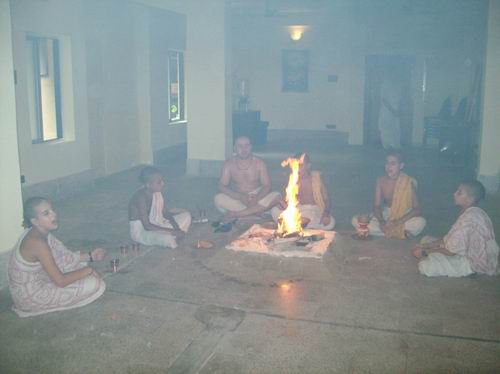
The day started with the transcendental chanting of the young brahmanas from the Mayapur Bhaktivedanta Academy, led by Bhagisar prabhu.
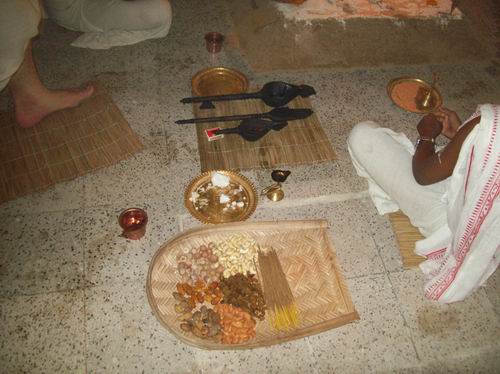
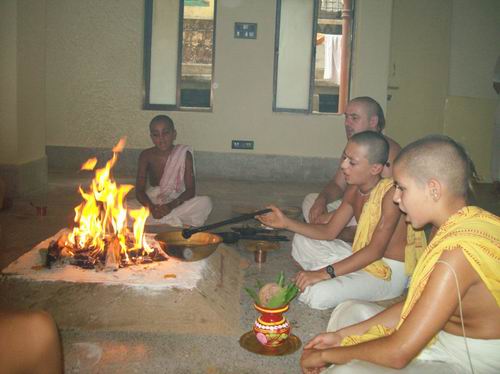
From 7.30 AM to 8.30 AM these young trainee priests expertly chanted ancient and modern mantras, filling the air with purifying smoke and sound vibrations in praise of the Lord and His devotees.
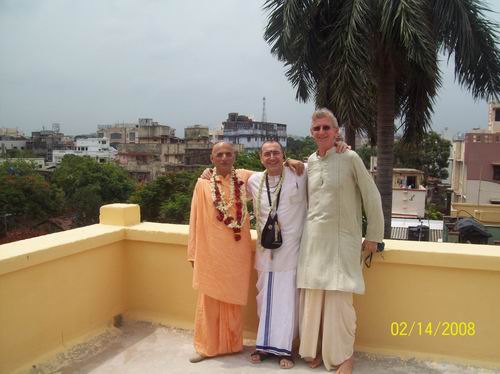
With the scene thus perfectly set, we gladly received HH Bhakti Charu Swami at 1.00 PM. Sri Madan Chanda Shamsukha, our donor, along with his wife Geeta mataji, came to the entrance to offer Maharaja garlands and thanks for blessing this inaugural event.
Maharaja was then taken on a tour of the building.
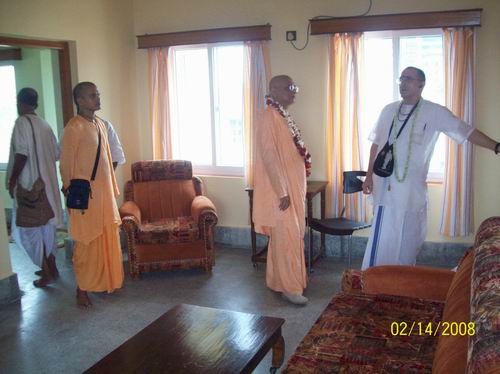
When he came on April 2, not much of the renovation was evident. However, this time he was able to see the completed library plus several rooms of the new guest house.
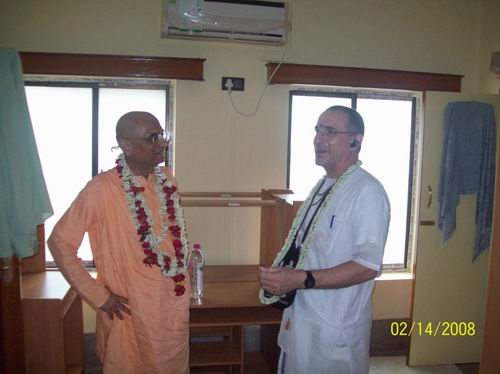
Although we were not able to demonstrate the computer system yet, which still needs one or two key components, Maharaja was very happy with the progress and inspired enough that he offered a donation of Rs. 5 lakhs (about $10,800 at today’s rate) in September, which should cover the remaining renovations for the 7 guest rooms. We are very grateful for his generous support and his sharing our vision for the project.
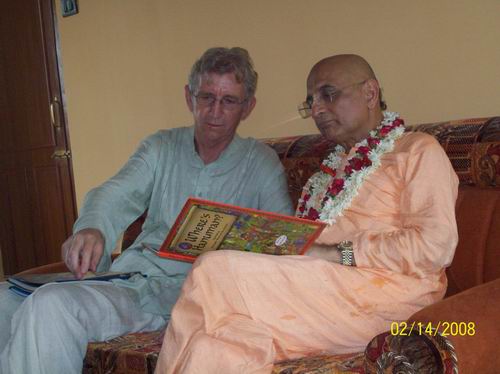
We took a brief respite in the VIP flat on the fifth floor, where Advaita Candra prabhu, the owner of Torchlight Publishers showed him some of their publications, including new title Where’s Hanuman? due to be released shortly.
Soon enough it was time to go down to the front entrance to receive HH Jayapataka Swami. Once again Mr. Shamsukha and his wife along with Bhakti Charu Maharaja were delighted to form the reception committee to receive him with fragrant garlands and deep appreciation.
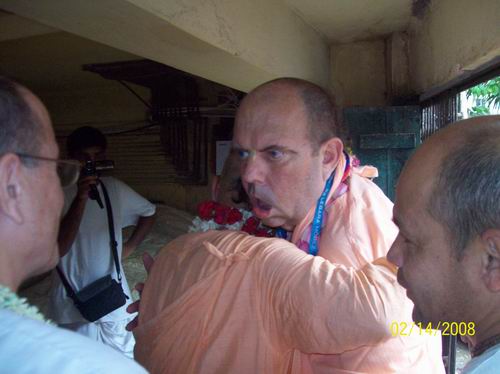
Jayapataka Maharaja is the living epitome of the drdha-vrata mahatma. His determination to go on with his preaching despite multiple bodily failures caused by his stroke, leave the onlooker in awe and deep respect.
May 25 2009
Here’s a question about observing birthdays from someone who prefers to be anonymous:
“During Prabhupada’s time, was there anything special done on devotee’s birthdays — particularly temple/ashram brahmacharis/devotees. Anything like a festival/program/feast or glorification for that devotee on that particular day. What was Prabhupada’s mood regarding this. Did he offer any special mercy to you on your birthday? What is our standard today?”
Answer:
There was no special observation of regular devotees’ birthdays. We were always taught that the only birthdays that should be observed were that of the spiritual master and the Supreme Lord.
Sometimes Srila Prabhupada followed traditional culture and offered some bangles or ornaments to small children on their birthdays. When his son Brindaban Candra had a baby girl, Srila Prabhupada gave him one of his gold rings as a gift for the child.
In Folio also you can find a letter addressed to Sally Agarwal where Srila Prabhupada gives his blessings to her baby girl on her third birthday and says:
New York
19 November, 1965
65-11-19
My dear daughter Sally,
I beg to thank you for your kind letter of the 16th instant and I have noted the contents carefully. I am glad to learn that you had been to your parents house for a few days and now you have returned home. I am still more glad to learn that you are going to observe the third birthday of Miss Kamala Agarwal on Saturday next. On this occasion I should have presented her some ornaments but as I am a Sannyasi I can simply offer my blessing for her long life and good prosperity. She cannot now read otherwise at least I should have presented a set of my books. But you set aside one set of my books for her future reading when she will grow up a beautiful and educated girls with full god consciousness. …”
I know a lot of devotees like to observe the birthday of other devotees with a cake or some other observation. Personally I don’t have any enthusiasm for observing birthdays and I have been known to completely forget my own.
These questions about prasadam and cooking for Srila Prabhupada are from Bhakta Shane:
Question:
Prabhu – I have few questions to ask and would appreciate if you could kindly speak about this subject.
I’m studying Ayurveda and alternative naturapathy and also want to eventually help to bring about better diet and health understandings for devotees as part of that study – for instance in Australia according to some devotees I’ve talked to there have been 9 devotees in last few years that have had their gall bladders removed – (gall bladder is there to break down fatty foods as part of its function ) so that is a very high statistic and probably avoidable as well. It would be a very good service if you could do this.”
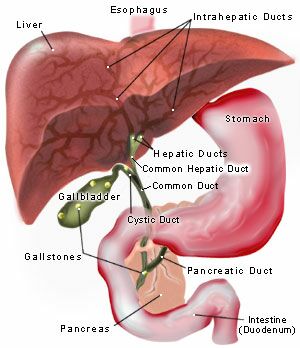
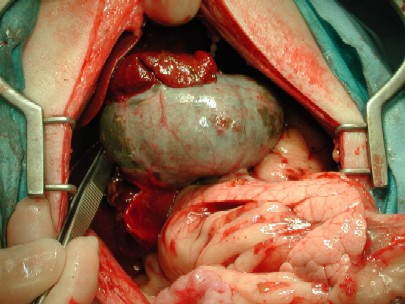
The body beautiful–how galling can it be?
Answer:
When I joined the Sydney temple in Feb. 1972 the prasadam was quite opulent. There wasn’t much sense of healthy eating. If it was offerable to Krsna, it was on the menu, and in no small measures either. The combination of ghee and sugar was a revelation that saved many a new devotee from blooping.
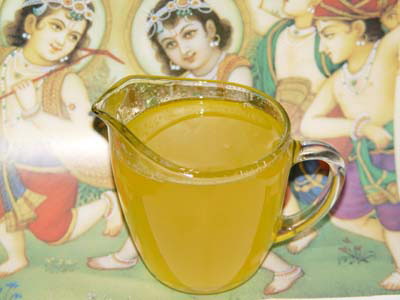
Oh ghee whizz! Saviour of the fallen!
Breakfast was quite simple, mainly fruits and homemade yoghurt and porridge. The real kick was lunch. Rice and dhal, homemade bread, vegetables soaked in ghee, varieties of sweets like rasagulla and gulabjamuns, sweet rice, puris, pakoras and lots of deep fried items.
On top of that, we had the “brahmacari offering” at about 6 PM every evening. We would return from our afternoon SKP, our youthful bodies having already digested the huge lunch and be feeling ravenous again. Most of us were brand new devotees and suffering sensory deprivation from our adoption of the devotional lifestyle. Eating was our compensation. Satisfaction of the tongue was our only sense enjoyment. So the cooks would make a large pot of halava with liberal amounts of nuts and raisins or a variety of berries,
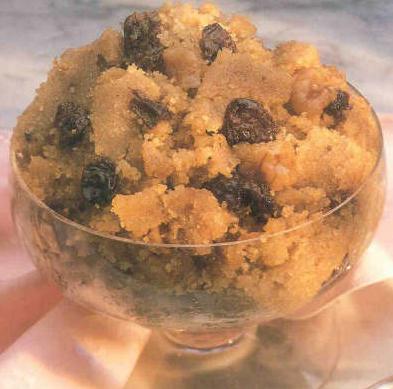
which would be offered to a picture in the kitchen and then distributed hot out of the pot. The trick was to make the halava with at least one inch of melted ghee floating on the surface. The brahmacaris would line up in the hallway outside the kitchen door with their stainless steel bowls, eager for their evening charge of sugar and ghee drenched grains.
And what to speak about the Sunday ‘love feast’.
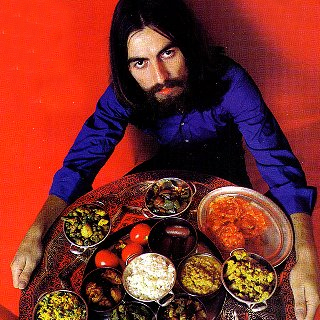
George liked a little appetizer too
It wasn’t uncommon for us (me anyway) to down at least three heaped platefuls of prasadam and then stash some for the evening or next morning. Bhakta Bernard I remember, once ate 13 bowls of halava for the feast and then stashed 6 more for his breakfast the next morning (Not surprisingly, he never got initiated and blooped after a few months).
My record was six plates in one Sunday feast. A short time after devouring the last one, I developed acute indigestion.
It got so progressively bad that I actually became afraid that I would collapse and die. Somehow after half an hour or so of morbid repentence and fervoured prayer

the pain in my midriff subsided and I took a solemn vow to never eat as much again. From that time on I restricted myself to a maximum of three plates at a sitting.
Well OK, I tell a lie. There was one occasion after that when we were on TSKP to Brisbane. It was a newly opened temple, populated mainly by ex-hippies and young counter-culture dropouts. We arrived in the double decker bus that had been converted into a traveling temple. The sign on the side of the bus read “The Hare Krishna Movement – The Positive Alternative”.
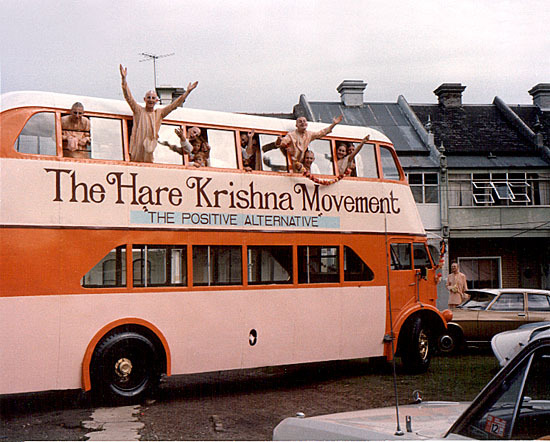
February 1972–Australia’s first traveling temple
I took the slogan to heart. The cooks didn’t really know much so the main sweet was “Simply Wonderfuls”
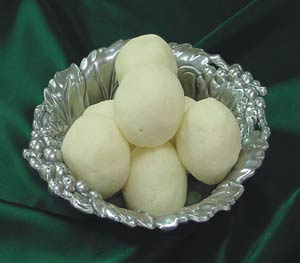
which were simply ghee, sugar and milk powder rolled into balls. Highly addictive. I ate 24 before developing extreme sugar burn in my throat and esophagus. After that I couldn’t look at one for about five years.
Anyway, I digress. When Srila Prabhupada arrived on April 1, 1972 on his second visit to Australia he stayed for a few days.
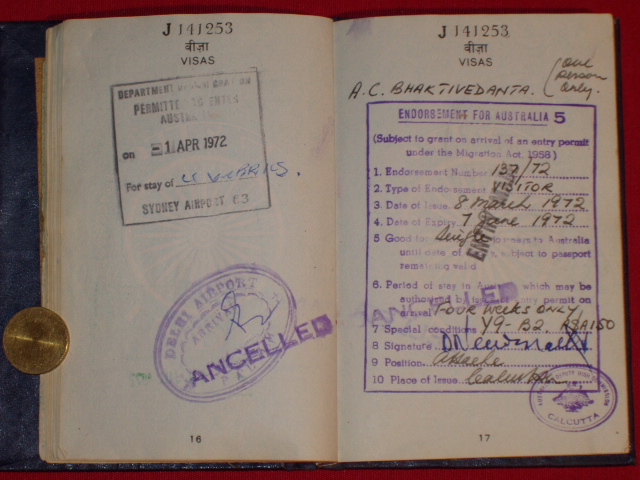
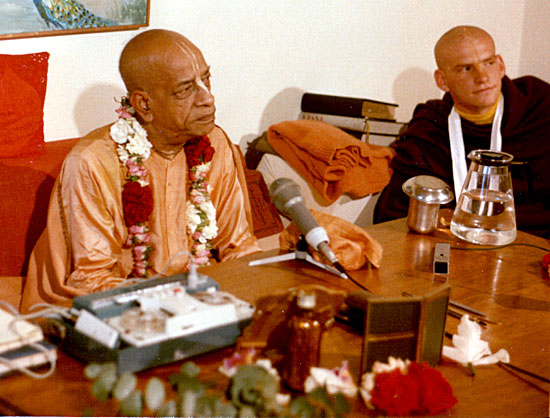
Srila Prabhupada, April 1972 with Mohanananda dasa, the Sydney temple president
May 12 2009
Here’s a wonderful service opportunity for anyone interested in information technology, storage and retrieval systems:
I just put this advert out on Dandavats.com
Head Librarian
The Bhaktivedanta Research Centre (BRC) situated at 110A Motilal Nehru Road, Kolkata 700029 is seeking a creative and enthusiastic librarian.
The successful applicant should ideally hold an MLS or B. Lib. Sci or have on-site experience of information management and be able and willing to lead a variety of services in the development of the BRC library:
• collection development
• marketing
• proposal writing (fund raising)
• providing user education to patrons
• liaison to various ISKCON bodies, the BBT, as well as secular institutions, libraries, centers of education, academics etc.
The librarian will develop the library in a variety of formats; develop and manage exhibits and outreach events; research external funding sources, write proposals, be detail-oriented and have a minimum of several years of computer experience.
Librarian must have strong communication, presentation, and interpersonal skills and be able to assess patron information needs to determine appropriate information resources to meet patron requirements.
Work will include research, serials management, cataloging collection development, instruction on accessing library services, acquisition of hard-copy and electronic information resources, website maintenance and customer service.
Librarian must be fluent in English and a working knowledge of one or more of Bengali/ Hindi/ Sanskrit is a big plus.
We would like to stress that this represents an ideal opportunity for devotional service in the academic field and should be seen from that perspective, rather than as merely a work or job opportunity. Modern accommodations and a basic stipend will be provided to the successful candidate.
——————————————————–
If you are interested, or you know someone who might be qualified and interested, please contact me.
May 6 2009
“A priceless treasure house of Vaisnava lore…” — Srila Prabhupada 1972
An exciting new ISKCON project is taking birth in Kolkata, the city of Srila Prabhupada’s birth.
The location is four-story building in the heart of Kolkata.
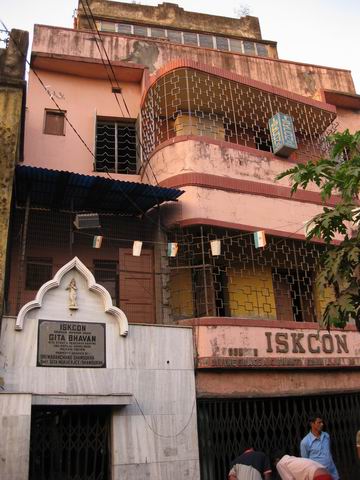
The building was donated to ISKCON in 2000 by Sri Madan Chanda Shamsukha and his wife Srimati Geeta Mukherjee Shamsukha.
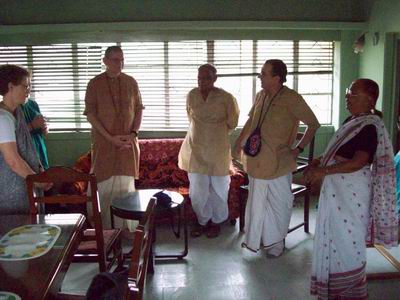
Praharana dasi, Ravindra Svarupa dasa, Mr. MC Shamsukha, Hari-sauri dasa, Mrs. Geeta Mukherjee Shamsukha.
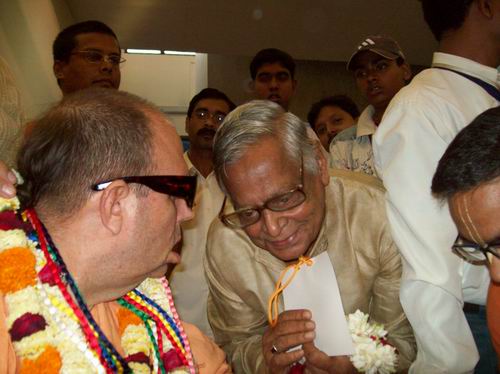
Mr. Shamsukha getting the blessings of HH Jayapataka Swami for the project.
Known as “Gita Bhavan” the building is being transformed into a major research centre and guest house. The Bhaktivedanta Research Centre (BRC) is an exciting new facility aimed at providing a ‘one-stop’ resource for the world-wide academic and Vaisnava community concerned with Vedic studies and in particular, Gaudiya Vaisnavism.
The library has five main sections:
• Vedic library, containing the Vedic literature and the commentaries of the leading acaryas along with all Srila Prabhupada’s books.
• Gaudiya Vaisnava original literature and commentaries
• Vedic cosmology
• Old manuscripts and rare books identification and preservation
• Bhagavad Gita library with all language translations of Srila Prabhupada’s Bhagavad-gita As It Is, plus the commentaries of the previous acaryas.
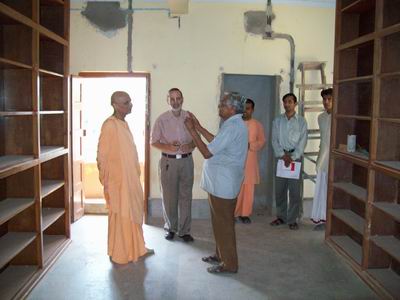
HH Bhakti Charu Swami visited the work in progress on the library on April 2 2009—seen here with Acyuta dasa (center) and Mr. Shamsukha.
As well as the library there is a temple cum meeting hall for seminars etc.
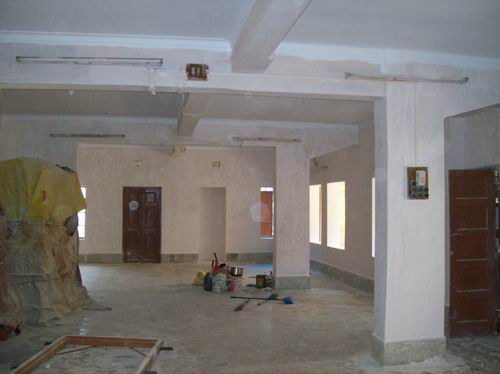
and three other floors are dedicated to a guest house for visiting scholars to stay.
Srila Prabhupada’s desire
Vedic Library
The inspiration to establish the BRC was born out of the direct desire of Srila Prabhupada. In August of 1976 Srila Prabhupada met with the temple president of Bombay, Giriraja dasa Brahmacari, and his former servant Nitai dasa, to discuss the establishment of a library in the new Bombay Juhu temple:
Hari-sauri dasa recorded this meeting in Volume 4 of his Transcendental Diary series:
August 15 1976 – Bombay
“There was no darshana this afternoon, although Srila Prabhupada did go up onto the roof to sit for a while with a few devotees. Then it began to rain so he returned to his sitting room. There he met with Giriraja and Nitai prabhus to discuss requirements for a library for the new building. Nitai has been given Rs. 4,000 by the temple to purchase books for it. Srila Prabhupada said the library should contain all his own books, those of all the acaryas, as well as the Upanisads and other bona fide Vedic texts. He said even those of Sripad Sankaracarya could be included — but not anything from Gandhi, Vivekananda or Rama-tirtha. “They are all rascals,” he said. “The Vedas instruct us that we should not even look at their faces.”
I was puzzled. “Doesn’t Caitanya Mahaprabhu instruct that if anyone read’s Sankaracarya’s books he is doomed?”
“Not if he reads with proper understanding,” Prabhupada said. “We can read to know what is their philosophy.”
[end quote]
Later in 1976 in a meeting with Dr. Theodore Kneupper, professor of oriental philosophy at Slippery Rock University, Arkansas, the idea of this Vedic library was again mentioned:
November 6 1976 – Vrndavana
[Srila Prabhupada’s secretary Jagadisa dasa is reading a news article about ISKCON to Srila Prabhupada and Dr. Kneupper]
“In fact, many Westerners come here to discover the real India for themselves, (indistinct) life experience. For this reason we are building a model Vedic community at our Juhu center in Bombay, providing all the modern amenities for scholars, students, and sophisticated inquirers from abroad as well as from India who can study the original Indian culture and practice. The center will include a Vedic library, theater, prasadam restaurant, gurukula school, an international guesthouse, as well as a temple and asrama.’
[end quote]
Unfortunately for various reasons the work was never completed. To this day ISKCON has no such library facility and this will be a major provision of the BRC.
Vedic Cosmology
The necessity for a library dedicated to Vedic cosmology became apparent as soon as Srila Prabhupada started talking about building the Temple of the Vedic Planetarium (TOVP) in Mayapur. Ravindra Svarupa prabhu recalls discussing the planetarium concept with Srila Prabhupada in Mayapur and then going into Calcutta to study the idea further. He had the realization that unless we have a library of all materials dealing with Vedic cosmology, the TOVP would not be taken seriously by the very people it was meant to attract–scholars and cosmologists from around the world. The history of delay in the building of the TOVP need not be dwelt upon here, but after many years, the realization of Srila Prabhupada’s dream seems immanent and the need to establish the library is imperative.
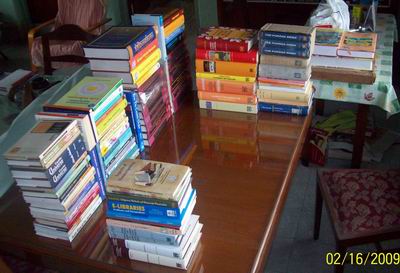
Purchase of cosmology books has already begun
Several years ago a cosmology team was formed to begin the research for the TOVP. With funding from Ambarish prabhu the team began talking seriously about establishing a library and last year in February 2008 the cosmology team were given the facility of a large 1100 sq. ft. hall in the building in Kolkata.
Gaudiya Vaisnava studies
Another aspect of the center was developed in conversation with Sriman Pranava dasa from Gothenburg Sweden who is completing his dissertation on the life of Srila Bhaktisiddhanta Sarasvati Thakura this summer (2009). He has had a long held ambition to establish a center for studies related to Lord Caitanya and the Gaudiya Vaisnava movement.
Pranava prabhu has proposed the following:
“To initiate an ongoing and long term project for the mapping, collection, digitization, translation and study of literature belonging to or dealing with the Vaishnava tradition that developed from Caitanya (1486-1534) from the 16th century up to the present. The literature is written mainly in Bengali, Sanskrit, Hindi and English. The first aim is to collect a body of resources and bibliographies of primary and secondary literature at the BRC. The second is to conduct research and translation of these resources. The third is to make available these materials to the larger academic community and the general public. The project may facilitate research in a number of more specific areas as theology, sociology, history of ideas, philosophy, gender studies, anthropology and science. The project may also result in closer cooperation between a properly run center such as the Bhaktivedanta Research Centre and relevant academic departments and universities in India and around the world.”
The BRC is now working with Pranava prabhu to make this proposal into a reality.
Manuscript preservation
The inspiration for the final component for the center came from an exchange of letters between Srila Prabhupada and his disciples in 1972 regarding some hand-written manuscripts of Srila Bhaktivinoda Thakura which at that time were in the hands of his son, Srila Lalita Prasada Thakura:
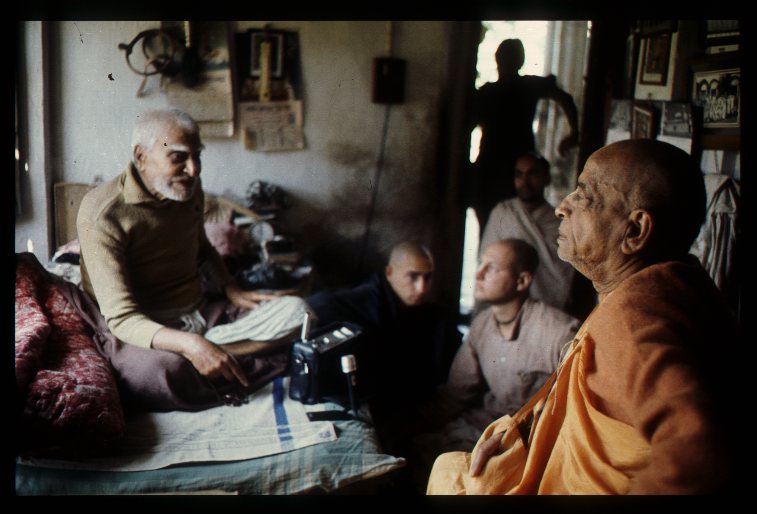
Srila Lalita Prasada Thakura, Acyutananda Swami, Gurudasa and Srila Prabhupada
In a letter to Acyutananda Swami dated 12 June, 1972 Srila Prabhupada told him:
April 28 2009
This is just in from Daria prabhu, who has just taken up the service of being my new translator on Krishna.ru
“My son Ganesha das and I have met with you in Mayapur last year in November, you even wrote my son’s name “Ganesha prabhu” in the book “Diary” that you wrote and published. My son is 11 years old and you wrote him “prabhu” – it was first time in his life 🙂
Answer:
“Certainly he is our prabhu. These great souls are the future hope of the Krsna consciousness movement, and the fact that they have been given the opportunity to take up Krsna consciousness right from the very beginning of their lives is an indication that they were advanced devotees in their last lives. So they may well be far more advanced than we are and are thus worthy of being addressed as prabhu.”
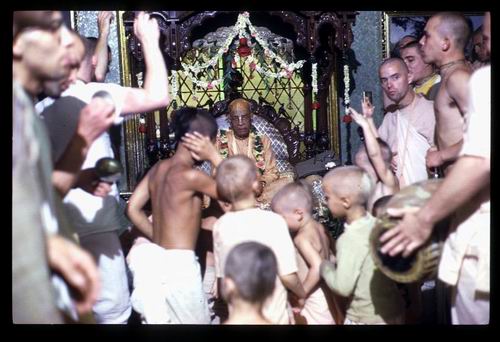
October 28 1976 – Vrindavana
[TD5-SB class]
Prabhupada’s attempt to provide the best possible opportunity to those pious souls who have been given the connection to Krsna through birth is displayed in his ongoing concern for the development of the gurukula. Surveying the young boys sitting attentively before him, he explained: “[They are] ringing the karatalas, chanting, dancing, offering obeisances to the Lord–temple atmosphere. Don’t think it is ordinary opportunity. It is very great opportunity. From the very beginning of life they are getting impression, bhakti yoga. Vasudeve bhagavati bhakti yoga. These are not going in vain. Even a child is playing karatala, imitation. Not imitation. He’s given the chance. He was previously Vaisnava. Somehow or other, he could not make his life perfect. Therefore he is given again chance. So naturally he has got tendency to play the karatala, to offer flower here, to offer obeisances. They take pleasure. It is due to previous life, yoga. But it was not perfectly done, so somehow or other they are getting chance from the very beginning of life.”
OK, I digress. Here’s the actual question:
Daria: I consider it an honour to try and translate your answers and questions of our people to you.
Here is the first question. It’s from Seva (male).
“Usually the sense of love and thankfulness rises within me towards people who give from their heart freely. For example if I see some devotees who sacrifices their own wishes to Krishna or to other beings, I feel sympathy for these devotees and I really wish to give something good to them. How can I love Krishna if all He is doing is always taking pleasure and nothing more?”
Answer:
I think Seva prabhu has yet to understand the real nature of love. It is apparent that he is setting conditions on the activities of those he wants to give his love to, and if those persons do not meet his personal requirements or standards, he does not feel inclined to love them. This is not love, this is Seva prabhu’s sense gratification. He wants everyone to be subordinate to his so-called love.
As far as Krsna goes, what can we say about the statement “How can I love Krishna if all He is doing is always taking pleasure and nothing more?” Does Seva prabhu seriously think this is all Krsna is doing?
Krsna’s position is perfectly described in Bhagavad Gita Bg 5.29:
bhoktaram yajna-tapasam
sarva-loka-mahesvaram
suhrdam sarva-bhutanam
jnatva mam santim rcchati
TRANSLATION
“A person in full consciousness of Me, knowing Me to be the ultimate beneficiary of all sacrifices and austerities, the Supreme Lord of all planets and demigods, and the benefactor and well-wisher of all living entities, attains peace from the pangs of material miseries.”

Krsna is described as the bhokta, the ultimate enjoyer. Why? Because He alone is the source of all the lokas, or planets and universes. He pervades the creation in his form as Supersoul, supplying all the necessities of life to every living being (not just humans). He provides the air we breathe, the water we drink, the earth we eat in the form of foodstuffs, the rainfall, the sunshine and every other aspect of our lives. The entire creation is simply a transformation of Krsna’s energies. Krsna is quite literally everything.
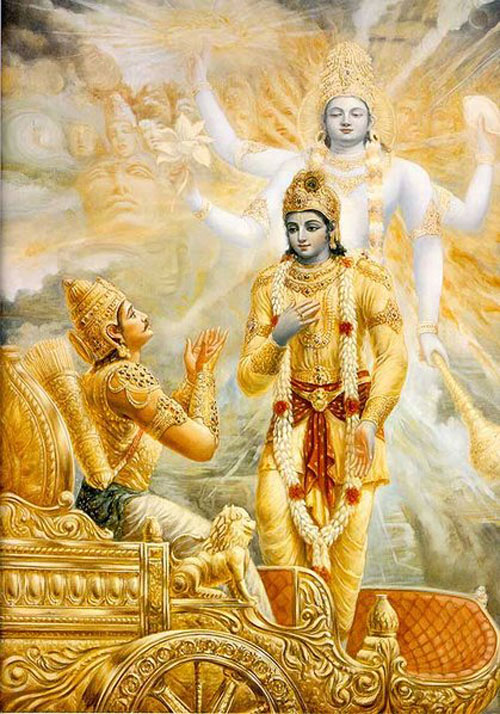
Everything and everyone is subordinate to Krsna’s will. He is second to none, the creator, maintainer and destroyer of all things, and He is the master of time. We are simply insignificant, infinitesimal particles of His existence. Without Krsna, we do not exist.
Even in ordinary logic we see that one who owns something, controls it. If you don’t own something, how can you control it? And one who controls something, has the right to enjoy it. If you don’t own something, and if you have no control over it, how can you enjoy it?